
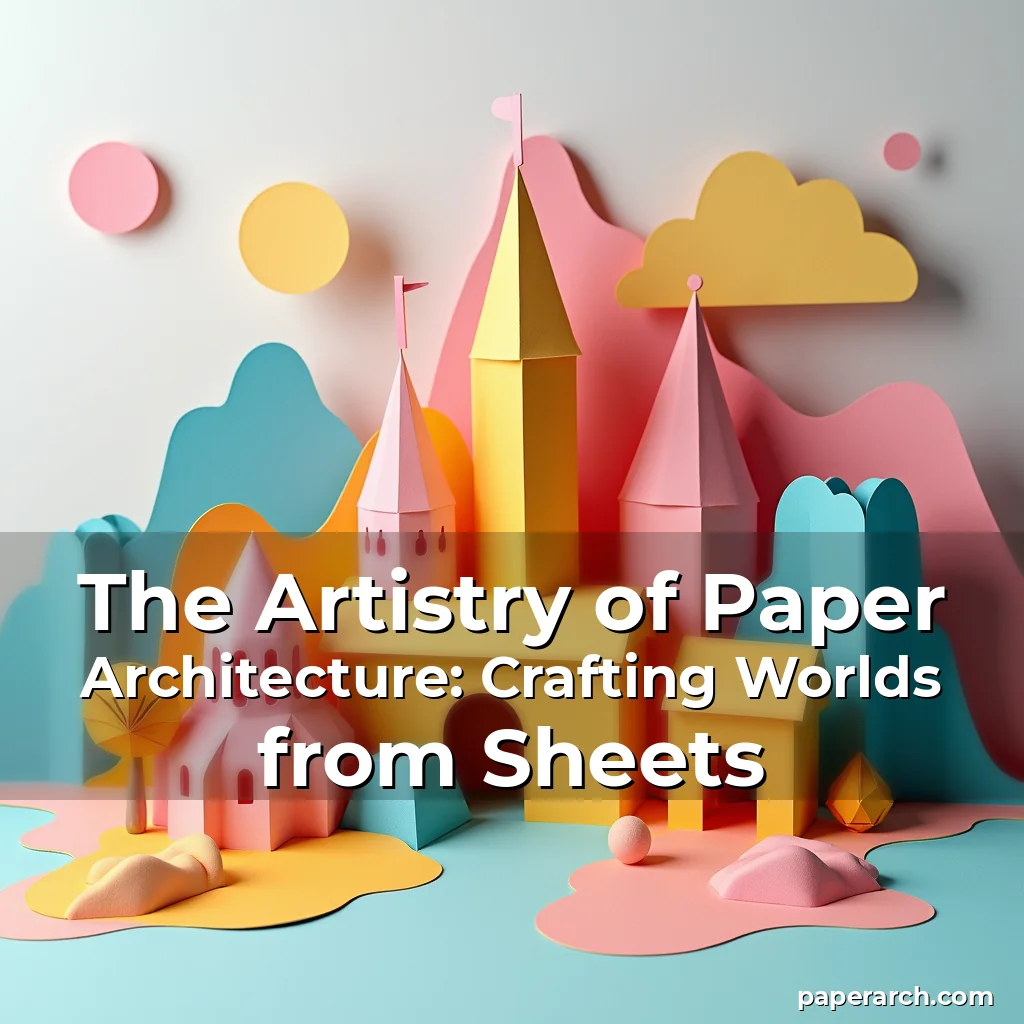
The Artistry of Paper Architecture: Crafting Worlds from Sheets
Paper architecture is an extraordinary blend of creativity and craftsmanship that transforms flat sheets of paper into intricate three-dimensional structures. This art form bridges the gap between design and construction, allowing artists to explore architectural possibilities without the constraints of materials and scale.
From miniature models to elaborate dioramas, paper architecture offers endless opportunities for expression and innovation. It invites both professionals and enthusiasts to engage with spatial relationships, structural integrity, and aesthetic principles through hands-on experimentation.
The Origins and Evolution of Paper Architecture
Paper architecture has deep historical roots, tracing back to ancient civilizations where artisans used parchment and paper to create decorative elements and simple models. These early forms were often ceremonial or instructional, serving practical purposes while showcasing artistic flair.
During the Renaissance period, architects began experimenting with paper as a medium for sketching and model-making. This era saw the emergence of detailed drawings and scaled-down replicas of buildings, which became essential tools for conveying complex designs to patrons and builders alike.
In the modern era, paper architecture has evolved beyond mere sketches and prototypes. Contemporary practitioners now push the boundaries of what can be achieved with paper, incorporating techniques such as origami, laser cutting, and digital modeling to craft highly sophisticated pieces.
- Historical Context: Ancient use of paper for ceremonial decorations and educational diagrams laid the foundation for its role in architecture.
- Renaissance Influence: The development of perspective drawing during this time allowed for precise representation of architectural ideas on paper.
- Modern Innovations: Today’s artists employ advanced technologies to manipulate paper in ways previously unimaginable, leading to new artistic expressions.
Fundamental Techniques in Paper Architecture
Creating paper architecture involves mastering several fundamental techniques that enable the transformation of two-dimensional material into lifelike three-dimensional constructs. Understanding these methods provides a solid foundation for any aspiring artist or designer.
Cutting and folding are among the most basic yet crucial skills required in paper architecture. Precision in these areas ensures accurate shapes and clean edges, which contribute significantly to the final appearance of the piece.
Scoring is another technique widely employed by practitioners. By lightly creasing along intended fold lines, artists ensure smoother bends and greater durability when constructing their models.
Sewing and gluing serve different functions depending on the complexity and desired outcome of the project. While sewing adds strength and flexibility, gluing provides quick assembly but may limit future modifications.
- Folding: Essential for creating depth and dimensionality; careful execution results in crisp, defined angles.
- Cutting: Requires precision to achieve symmetry and proportion; mistakes here can affect overall aesthetics.
- Gluing: Offers rapid assembly but demands attention to alignment to prevent misalignment issues later on.
Materials and Tools Used in Paper Architecture
Selecting appropriate materials and tools plays a vital role in achieving successful outcomes in paper architecture projects. Different types of paper offer varying degrees of rigidity and texture suitable for various applications within the field.
Cardstock is commonly preferred due to its thickness and durability compared to regular printer paper. Its firmness makes it ideal for supporting structural components without warping easily under pressure.
Bond paper, though thinner than cardstock, remains popular among those who prioritize ease of manipulation over extreme resilience. It allows for more delicate detailing work while still providing sufficient support for simpler constructions.
Specialty papers designed specifically for crafts include vellum, which offers translucent qualities perfect for layered effects, and washi, known for its traditional Japanese textures and patterns.
- Cardstock: Provides sturdy base for robust structures requiring minimal reinforcement.
- Vellum: Enables creative layering capabilities useful in transparent overlays or shadow play.
- Washi: Adds cultural authenticity and visual interest through distinctive surface characteristics.
Applications Beyond Aesthetics: Practical Uses of Paper Architecture
While many view paper architecture primarily as an artistic endeavor, there exist numerous practical applications where this skill proves invaluable across various industries and disciplines.
Educational institutions frequently utilize paper architecture as teaching aids to help students grasp abstract concepts related to geometry, engineering principles, and environmental science through tangible examples they can interact with physically.
Architectural firms sometimes produce small-scale paper models as preliminary representations before proceeding with full-sized builds. These models assist clients in visualizing proposed designs effectively prior to committing significant resources towards actual construction efforts.
Interior designers also benefit from using paper architecture techniques when presenting layout proposals since they allow for easy adjustments based upon client feedback without costly alterations being made prematurely.
- Education: Enhances learning experiences by making theoretical knowledge accessible through physical interaction.
- Design Visualization: Allows stakeholders to better understand spatial arrangements before investing heavily into real-world implementations.
- Prototyping: Facilitates iterative testing phases enabling refinement of ideas quickly and affordably.
Notable Artists and Their Contributions to Paper Architecture
The world of paper architecture boasts several renowned individuals whose works have not only elevated the status of this niche discipline but also inspired countless others pursuing similar paths.
Jiro Taniguchi, although primarily recognized for his contributions to modernist architecture, incorporated paper-based elements extensively in his studies at Tokyo University. His emphasis on functionality combined seamlessly with minimalist aesthetics influenced generations of architects worldwide.
Makoto Yamaguchi stands out as a contemporary figure dedicated exclusively to exploring the potentialities inherent within folded paper structures. Through meticulous calculations and innovative folds, he creates stunningly realistic landscapes that defy conventional expectations regarding what paper alone could accomplish visually.
Other notable names include Kseniya Simonova, known for her whimsical interpretations blending nature themes with geometric precision, and Robert J. Lang, celebrated for advancing mathematical approaches applied to origami techniques applicable even outside traditional contexts like toy manufacturing or packaging solutions.
- Taniguchi’s Legacy: Emphasized functional beauty influencing global architectural trends emphasizing simplicity alongside utility.
- Yamaguchi’s Vision: Demonstrated how seemingly fragile mediums can yield breathtakingly intricate depictions mimicking natural phenomena accurately.
- Simonova & Lang: Expanded horizons showing versatility of paper application ranging from artistic endeavors to technical problem-solving scenarios.
Challenges Faced by Practitioners of Paper Architecture
Despite its appeal and growing recognition, practicing paper architecture presents certain challenges that require patience, adaptability, and continuous learning processes to overcome successfully.
One primary challenge lies in maintaining consistency across large surfaces when working manually—especially true for ambitious undertakings involving extensive folding sequences resulting in multi-layered compositions.
Another issue pertains to ensuring stability once assembled; improperly secured joints might cause disintegration over time unless reinforced adequately according to each component’s requirements dictated by load-bearing capacities involved.
Environmental factors such as humidity levels pose additional difficulties affecting dimensional accuracy negatively especially if left exposed outdoors without protective coverings against moisture absorption potentially distorting delicate features permanently.
- Manual Consistency Challenges: Large scale projects demand high level of manual dexterity risking errors increasing exponentially with size complexity.
- Structural Integrity Concerns: Proper adhesion techniques critical to longevity preventing premature degradation caused by weak bonding points.
- Climate Sensitivity Issues: Paper prone to absorbing ambient conditions necessitating controlled environments preserving original intent intact long term.
The Future Landscape of Paper Architecture
As technology continues evolving rapidly alongside shifting societal priorities concerning sustainability initiatives, the landscape surrounding paper architecture appears poised for exciting developments ahead.
Advancements in biodegradable materials coupled with enhanced printing methodologies promise novel avenues exploration merging eco-conscious practices simultaneously expanding creative possibilities available today compared historically limited options.
Digital fabrication tools including CNC machines capable producing highly accurate cuts eliminating human error entirely revolutionize production speeds enabling mass customization feats unattainable manually before.
Collaborative platforms facilitating virtual reality interactions further transform engagement modes letting audiences experience immersive walkthroughs irrespective geographical limitations separating creators from viewers globally.
- Sustainable Practices: Integration of environmentally friendly substances reduces ecological footprint aligning industry goals promoting green alternatives actively.
- Digital Fabrication: Automation streamlines creation cycles drastically improving efficiency metrics associated traditionally labor-intensive tasks formerly performed manually.
- Virtual Engagement: Technological innovations foster cross-cultural exchanges enhancing accessibility promoting inclusivity within broader communities interested participating regardless location barriers present.
Conclusion
Paper architecture represents more than just an artistic pursuit—it serves as a powerful tool bridging imagination with tangible realization offering profound insights into spatial dynamics through tactile engagement.
Whether approached casually as hobbyists experimenting freely or pursued professionally demanding rigorous technical expertise, embracing paper architecture opens doors toward discovering fresh perspectives reshaping our understanding built environments fundamentally altering perceptions regarding what constitutes’real’ versus ‘virtual’ spaces coexisting harmoniously together.