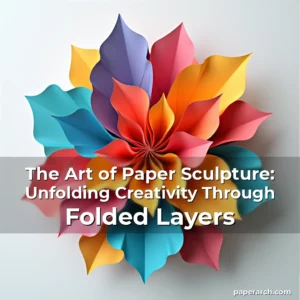

The Art of Paper Sculpture: Crafting Three-Dimensional Wonders from Flat Surfaces
Paper sculpture is an ancient yet ever-evolving art form that transforms simple sheets of paper into intricate three-dimensional masterpieces. From delicate origami flowers to elaborate architectural models, artists have long explored the expressive potential of paper through folding, cutting, and layering techniques.
This guide delves deep into the world of paper sculpture, examining its historical roots, modern applications, and the creative possibilities it offers both beginners and seasoned artisans alike. Whether you’re looking to create your first folded masterpiece or refine advanced skills, there’s something here for every level of interest.
Historical Foundations of Paper Sculpture
The origins of paper sculpture trace back over two thousand years to ancient China, where papermaking was invented during the Han Dynasty around 2nd century BCE. This innovation laid the groundwork for artistic experimentation with paper as a medium.
In traditional Japanese culture, origami evolved from ceremonial practices involving paper cranes and other symbolic forms. These early examples demonstrate how paper could convey meaning beyond mere decoration.
Cultural exchange along the Silk Road facilitated the spread of paper-making technology across Asia and eventually Europe by the 12th century. This global dissemination allowed diverse traditions to develop distinct styles of paper manipulation.
During the Renaissance period, European artists began experimenting with papier-mâché techniques that combined paper pulp with adhesive materials. These methods enabled the creation of larger-scale sculptural works.
- Origami: A Japanese art form emphasizing precise folds without cuts or glue
- Kirigami: An extension of origami incorporating strategic cuts to achieve complex shapes
- Papier-mâché: Techniques using soaked paper pulp mixed with binding agents
Modern Applications and Innovations
Contemporary artists continue pushing the boundaries of what paper can accomplish when manipulated creatively. Today’s paper sculptures range from minimalist installations to massive environmental artworks made entirely of recycled materials.
Digital tools now complement traditional handcrafting methods. Laser cutters enable precision work at scales previously unimaginable while 3D modeling software helps plan complex structures before physical construction begins.
Educational institutions increasingly recognize the value of paper sculpture in teaching spatial reasoning and fine motor skills. Many schools integrate these activities into STEM curricula alongside arts education programs.
Architects use scaled paper models to visualize building designs before actual construction commences. These maquettes allow for cost-effective testing of structural elements and design aesthetics.
Essential Materials and Tools
A successful paper sculpture project requires careful selection of appropriate materials. Artists choose between various paper types based on desired texture, weight, and durability characteristics.
Common choices include cardstock for sturdier constructions, tissue paper for translucent effects, and handmade papers offering unique textures and patterns. Specialty stores often carry imported papers specifically designed for sculptural purposes.
Beyond basic supplies, specialized tools enhance efficiency and accuracy. Bone folders help create crisp creases while tweezers assist with delicate positioning tasks requiring extreme precision.
For those working digitally, laser engravers and CNC machines provide new ways to manipulate paper surfaces with machine-assisted precision. These technologies open up exciting possibilities for mass production of intricate designs.
Environmental considerations are becoming increasingly important in material selection. Recycled papers and biodegradable adhesives offer sustainable alternatives without compromising artistic quality.
Fundamental Techniques for Beginners
Newcomers should start with basic folding techniques before progressing to more complex methods. Understanding fundamental principles allows gradual development of confidence and skill levels.
Practice creating simple geometric shapes like cubes and pyramids to build muscle memory for manipulating paper effectively. These foundational exercises also teach proportion awareness crucial for more ambitious projects.
Experimentation with different fold angles reveals how subtle changes affect overall structure stability. Keeping meticulous records of successful configurations aids future reference and refinement efforts.
Mastery of valley folds (concave bends) and mountain folds (convex bends) enables control over shape formation. Combining these elementary moves creates endless combinations for creative exploration.
Patience is essential when learning any new artistic discipline. Progress may seem slow initially but consistent practice leads to noticeable improvements over time.
Advanced Methods and Creative Possibilities
Experienced artists explore sophisticated approaches such as modularity and interlocking components. These techniques allow for dynamic compositions that change appearance depending on viewing angle.
Sculptors incorporate layered transparency effects by strategically placing colored tissues against white backgrounds. This method adds depth perception while maintaining visual lightness.
Hybrid media integration introduces unexpected elements like metal accents or fabric embellishments that enrich visual narratives within paper-based works.
Installation art utilizing hundreds or even thousands of individual pieces demonstrates how repetition becomes powerful when executed consistently with attention to detail.
Interactive sculptures invite audience participation through movement-sensitive mechanisms activated by touch or motion sensors integrated discreetly within the artwork itself.
Notable Artists and Their Contributions
Several contemporary creators have significantly influenced the field through innovative approaches and technical advancements. Their works inspire both professional practitioners and amateur enthusiasts worldwide.
Ryoji Ikeda explores mathematical concepts through abstract paper formations that challenge perceptions of space and dimensionality. His kinetic installations mesmerize viewers with fluid transformations occurring in real-time.
Hiroshi Yoshida developed pioneering techniques for achieving photographic realism in his nature studies using finely detailed paper cutouts arranged meticulously to capture natural scenes accurately.
Margaret Calvert’s typographic designs demonstrate how paper can serve functional purposes while remaining aesthetically pleasing. Her highway sign systems remain iconic examples of effective communication through minimalistic forms.
Artists like Erwin Redl combine digital projection mapping with traditional paper crafting to produce immersive environments where static objects interact dynamically with changing light conditions.
Creating Your Own Paper Sculptures
Beginners should approach their first attempts with realistic expectations regarding difficulty levels associated with each technique they try. Starting with simpler projects builds confidence necessary for tackling more challenging endeavors later.
Selecting suitable subjects depends largely on personal interests and available resources. Nature themes offer rich subject matter easily adaptable through careful observation and study sessions outdoors.
Sketching preliminary ideas provides direction before committing to actual paperwork. Visualizing end results mentally helps identify potential challenges that might arise during execution phases.
Testing small prototypes allows identification of problematic areas needing adjustment before investing significant effort into full-scale productions. Iterative refinement improves outcomes progressively over repeated trials.
Joining local craft communities offers opportunities to learn from experienced makers who generously share knowledge gained through years of dedicated practice.
Preservation and Display Considerations
Proper care ensures longevity of paper sculptures which can degrade over time due to humidity fluctuations and exposure to direct sunlight. Environmental factors play critical roles in determining lifespan expectancy.
Display cases equipped with controlled climate settings protect sensitive pieces from moisture damage while allowing visibility without risking deterioration from handling activities.
Digitally capturing high-resolution images serves dual purposes – preserving visual documentation and enabling virtual exhibitions accessible globally regardless of geographic constraints.
When transporting delicate works, custom-made protective packaging prevents accidental damage caused by shifting movements inside standard containers lacking adequate cushioning features.
Conservation experts recommend regular inspections for signs of weakening fibers or discoloration indicating need for intervention before irreversible harm occurs.
Conclusion
Paper sculpture remains a captivating medium blending tradition with technological advancement continuously expanding its horizons. Its versatility makes it appealing across generations seeking meaningful engagement with tactile creativity.
Whether exploring classic origami techniques or embracing futuristic hybrid media applications, anyone can discover joy in transforming flat surfaces into breathtaking three-dimensional wonders through thoughtful craftsmanship and imagination.